Proven technology.
New Zealand integration.
Internationally proven continuous-feed pyrolysis systems, integrated with local engineering, independent review, and Western-standard emissions controls.

WHAT IS PYROLYSIS?
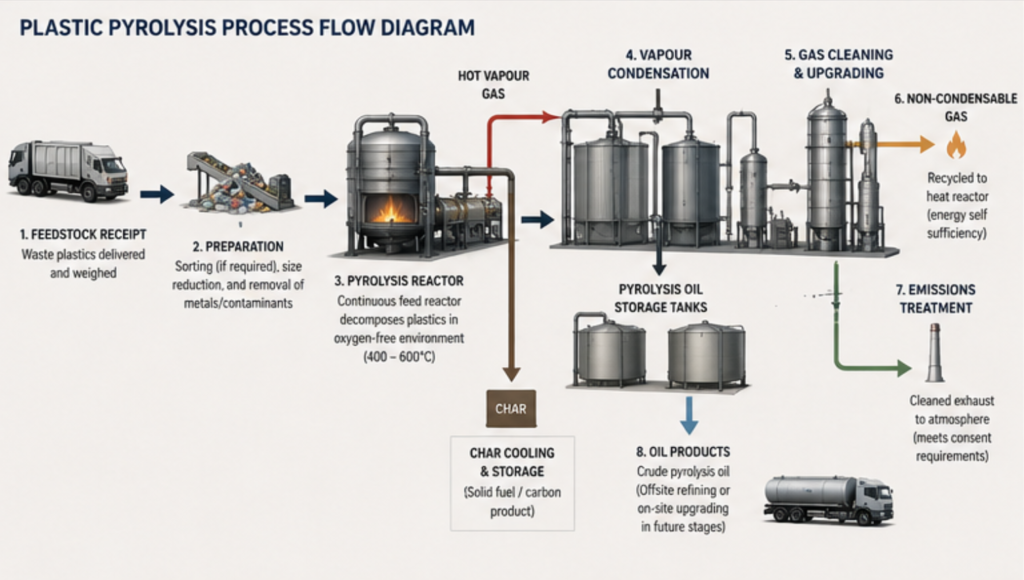
Pyrolysis is a well-established thermochemical process that converts plastic waste into valuable products through thermal decomposition in an oxygen-free environment at temperatures of 400–600°C.
WHAT'S ITS BACKGROUND?
It has been in commercial operation internationally for over a decade and is increasingly recognised as a critical technology for chemical recycling and circular economy infrastructure.
HOW DOES IT WORK?
... AND THEN?
Inside the reactor, thermal decomposition produces hot vapour gas, which passes through condensation and fractionation systems to collect pyrolysis oil. Non-condensable gases are recycled internally to support the reactor’s energy requirements. Char is collected, cooled, and stored as a solid byproduct.
THE RESULT?
Outputs
Pyrolysis oil (60-75%)
Pyrolysis oil is the primary commercial product — usable as industrial boiler fuel, marine fuel blendstock, refinery feedstock, or chemical recycling feedstock, depending on quality and downstream processing.
CHAR (10-20%)
Char is a solid carbon product with potential applications as a fuel supplement, carbon material, or circular carbon product depending on feedstock composition and quality.
INTERNAL GAS (10-20%)
Internal gas is recycled within the facility to support reactor heating, reducing external energy consumption and improving the overall energy balance of the operation.
Our technology approach
South Pacific Energy Resources is pursuing a hybrid technology model: internationally proven continuous-feed pyrolysis process equipment combined with New Zealand engineering integration, local controls systems, Western-standard emissions treatment, and independent technical review.
This approach is designed to deliver the cost and scale advantages of proven international technology while ensuring the facility meets New Zealand environmental standards, operates with local engineering expertise, and is built with the transparency and independent oversight required for council and community confidence.
The technology selection process includes formal technical due diligence, operational reference checking, and independent engineering review — reflecting the project’s positioning as credible, long-term infrastructure rather than an unproven pilot.
Emissions and environmental systems
The facility is designed with fully enclosed buildings, advanced emissions treatment systems, odour control infrastructure, integrated stormwater management and bunding, and independent emissions monitoring. Emissions performance is a foundational design requirement — not an afterthought.